
Building a Cap Table in Three Weeks: How I Raised $300K Without Lawyers, Pitch Decks, or Unnecessary BS
Raising My Angel Round and Closing Co-Founders While Rebuilding From Scratch--IN 21 DAYS!

Welcome back to Scaling With Soul!
We're here to demystify entrepreneurship and make it more accessible to all. Before we dive into today’s topic, my next live office hours/AMA is Wednesday, October 22nd at 10am PT. Upgrade your sub to $10/mo level to join and bring your questions!
Today I’m sharing how I raised $300K and built my cap table for my new company in just three weeks. I’m sharing actual numbers and real conversations because founders need a roadmap—and every time I share details like this, founders tell me how incredibly helpful it is.
There’s this bullsh*t unwritten rule that we should keep all these things private, but I really don’t understand why. There’s no benefit to me—and it just creates artificial mystique that makes it harder for new founders to navigate these situations. I mean, why should everyone suffer through the same learning curve when those of us who’ve been through it can just...tell you how we did it? The only people who benefit from this secrecy are the gatekeepers charging $500/hour to explain what I’m about to tell you for free.

Just 21 days ago, a PE firm permanently shut down the product I personally designed to serve customers of the company I built from scratch and ran for 14 years. Team laid off, customers stranded. When I offered to buy it back—even had my angel ready to fund the entire purchase—they said no. Classic PE move: burn it down rather than let the founder rebuild what they couldn’t figure out how to run.
Just three weeks later I have $550K in funding, two co-founders locked in, a product build underway, and a cap table I built myself without fancy lawyers or consultants. Here’s exactly how it happened—and why it was easier than you might think.
Note: If you missed the back story and want more history on what happened, you can read more here and here (in that order) or you can watch my playlist on TikTok that I created to document the strange and unexpected journey of rebuilding my company at age 60.
The 21-Day Timeline: From Shutdown to Funded
Day 1-3: PE firm pulls the plug. Team laid off, customers scrambling
Day 4-10: Customer calls confirm what I already knew—they want this product back
Day 7: The midnight call with my angel (because that’s when busy CEOs are free)
Day 11-14: Financial modeling with Claude AI (because why pay consultants thousands for spreadsheet work?)
Day 15-18: Co-founder conversations and equity negotiations
Day 19: In-person meeting in L.A. with angel to close the deal
Day 21: Funding closed, co-founders lined up, cap table finalized
The $250K Personal Investment
Before I asked anyone else for money, I had to decide how much of my own I was willing to risk. After talking to former customers who said they relied on the product and wanted wanted it back up and running, as well as engineers about how AI would allow the product to scale in a way that had not been possible before, I made the call: I was going to invest $250K of my own money.
This wasn’t just about skin in the game—it was about proving to myself and potential investors that I believed in this vision enough to bet a quarter million of my own money on it. You can’t bullsh*t your way through that kind of commitment. Either you believe in what you’re building, or you don’t. $250K is a pretty clear signal of where I stood.
Getting My Original Angel On Board
I wrote extensively in my book Scaling With Soul, How I Built and Sold a $25 Million Tech Company Without Being an A**hole how I found my original angel back in 2008 and how easy it was for me to secure funding because we already had a relationship. Nearly two decades later, things have changed in some ways—but not at all in others. Today my angel is a public company CEO running a big organization and I am a much more experienced and confident founder who delivered an 11x return on investment. While we would always still be friends no matter what, our professional relationship also has legs—and he makes time for me no matter how busy he is.
Earlier this month, while I was on the East Coast, we finally connected after midnight my time—because that’s what it takes to get on the calendar of a public company CEO. I walked him through everything: customer validation calls, product development progress, financial projections, team building. No pitch deck, no fancy presentation. Just two people who’ve done this before having an honest conversation about whether this thing could work.
He was encouraged but cautious. “Look, I want to put in as little as possible, but as much as you need to make this successful. I’d prefer not to put in $500K. What do you think that number really is?”
We talked through scenarios ranging from $200K to $500K. I’d already built a financial model using Claude AI, incorporating all the costs I’d anticipated: product development, salaries, legal, marketing—everything.
When I plugged in $300K instead of $500K, the model still worked. We’d have sufficient runway to get to customer revenue, even with conservative revenue expectations.
“I think we can do this with $300K,” I told him. “And it gives us a lot more wiggle room in the cap table.” What this means, essentially, is it gave me room to issue more equity to my co-founders, while leaving plenty for critical new hires as well as rank-and-file hires willing to take the risk to join us early and wear a lot of hats, doing whatever needs to be done. Any serial founder knows these types of hires are important.
My DIY Cap Table
Here’s where my angel gave me the confidence I needed. As someone who’s founded multiple companies and now runs a public company, he said I didn’t need to hire high-priced lawyers and wait weeks to get this done. We agreed on the basics. He wanted a $2.5 million post money valuation. Some might look at my profile and say, “Girl, you’ve accomplished a lot. You settled too low.” But I’m a pragmatist. I trust this man, he’s the only one I wanted to take money from and this was going to be quick and relatively easy. I needed to build a team and a product by the end of the year and have customer revenue flowing in by Q126. I needed to roll up my sleeves and close this deal—not just with him, but with my two cofounders.
Could I have squeezed him for a better valuation? Maybe. Could I have spent weeks negotiating every detail and maybe gotten 500K more in post-money? Maybe. But that would have eaten up precious time when I’m laser-focused on one thing: getting this product to market and getting my customers back. That’s all I care about. If I execute on that—and I will—we’re all going to be paid back handsomely. I’d rather spend my energy building something valuable than dicking around in valuation negotiations. Speed wins, and every day spent haggling over terms is a day not spent serving customers.
This was revolutionary thinking for me. Back in 2008, I spent months on this process—and thousands on lawyers who charged me premium rates to fill out forms that are now available online for under a thousand bucks. The legal industry has been gatekeeping this basic work for decades, convincing founders they need expensive hand-holding for what amounts to paperwork. But my angel was right—Claude AI can answer basic funding and formation questions better than most junior associates, and online platforms handle these tasks safer and faster than law firms drowning in billable hour quotas.
When you’re a founder taking someone else’s money, you think you have to dot every i and cross every t with expensive lawyers. And you do need to be thorough—but there are modern tools that make the initial structure much more accessible.
I built my cap table myself with a little assist from Claude when I had questions. When my angel reviewed it as a very experienced investor, he thought it all made sense, even thought it might not be presented conventionally. The simplicity made it easy to explain to everyone—both new founders without experience as well as my seasoned investor.
I’m still going to have a lawyer draw up the actual share purchase agreements and stockholder agreements. But this cap table clearly laid out everything and made the story easy to tell: where the percentages came from, how I landed on $300K, why it gave me the wiggle room I needed.
The Final Cap Table: Complete Transparency
Here’s exactly how we structured the deal—because transparency beats mystique every damn time:
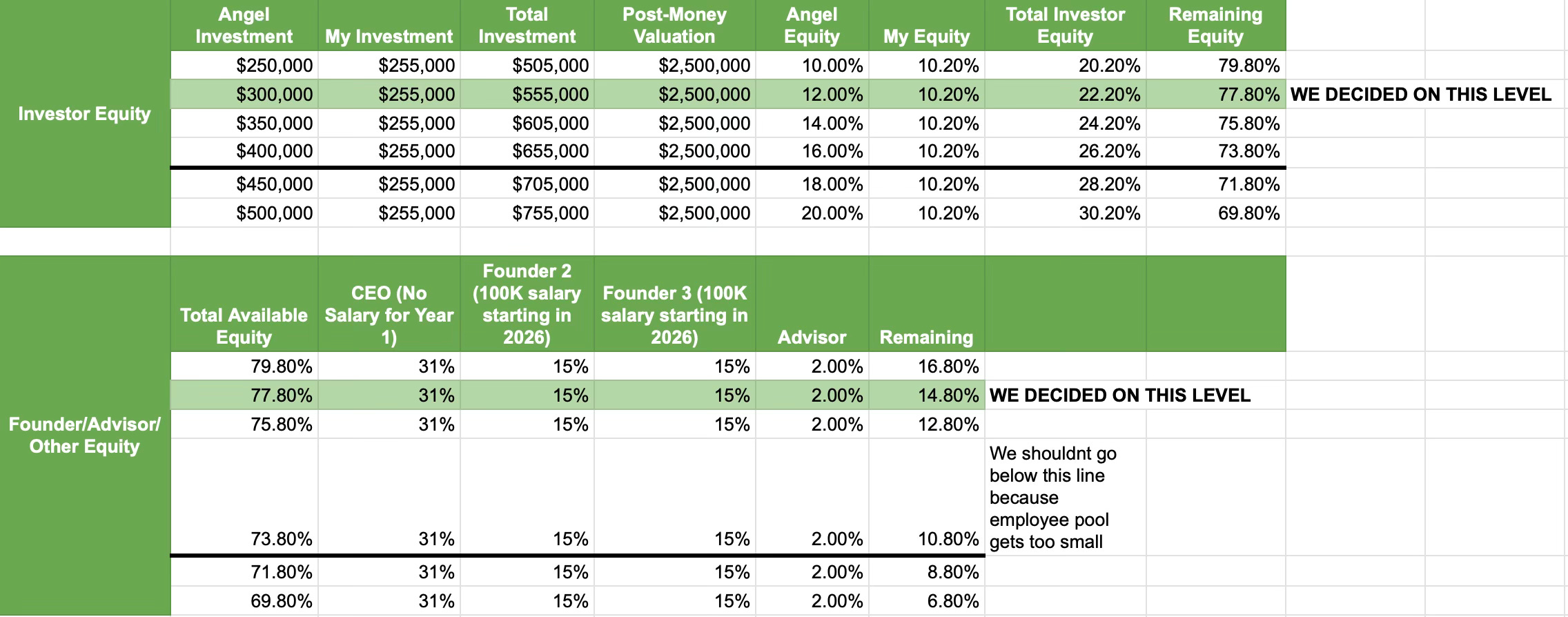
Post-Money Valuation: $2.5 Million
Sharon (Me): Investor Equity (10.20%) + Founder Equity (31%) = 41.20% equity. I am not taking a salary in 2026
Angel: 12% from a $300K investment
Co-Founders: 15% each plus 100K salaries in 2026
Key Advisor: 2% - Strategic guidance
Employee Pool: 14.80% - Future hires
Total Funding: $555K
I know I said I was putting in 250K but I spent $5K on setting up the business before we finalized all the details, so I just added it to the tab.
No lawyers, no months of negotiation, no complex term sheets that require a PhD to understand. Just experienced people structuring a fair deal that works for everyone.
The Co-Founder Conversations
With the funding structure set, I needed to have frank conversations with my potential co-founders. These are incredibly skilled people in their areas, but they’d never been founders before. I wasn’t sure if they were up for being true founders or preferred senior leadership roles.
I researched the differences extensively and presented each of them with a clear breakdown:
Senior Leader Role:
Executes within a defined domain (engineering, product, sales, etc.), reports to founders, focused on building their function, less strategic risk/responsibility
Salary-focused compensation
2-5% equity typical; standard 4-year vest with 1-year cliff
Defined responsibilities and hours
Less financial risk
Co-Founder Role:
Shared ownership of company vision and strategy, board-level decision making, significant risk-taking, expected to work through uncertainty without clear role boundaries, often wears multiple hats, commits for the long haul (4+ years typically)
Equity-heavy compensation
10-25% equity range; standard 4-year vest with 1-year cliff
All-hands-on-deck mentality
Significant financial risk and reward
I had individual conversations with each potential co-founder: “This is what a senior leader does versus a co-founder. What do you think you’re up for?”
Both chose the co-founder path—which meant they were signing up for the emotional rollercoaster, financial risk, and “whatever it takes” mentality that comes with building something from scratch. The equity allocation reflected that commitment. No surprises, no resentment later, no “I didn’t know what I was getting into” conversations six months down the road.
Why This Was Easy (And Why It Might Not Be For You—Yet)
The common thread through this entire process is relationships. I knew my angel for decades and he invested and got a great return from my previous company. I knew both co-founders and the key advisor had been in my network for years.
When you have established relationships built on trust and proven results, fundraising becomes an honest conversation rather than startup theater. My angel didn’t need a deck or financial projections—he needed to understand the opportunity and my commitment level.
I have built four companies and only one pitch deck—the one I used to raise venture capital for my only failed company. While other founders spend months perfecting slide presentations that investors will skim in 30 seconds, I spend that time building relationships and proving I can execute. It’s a choice.
If you don’t have these relationships yet, your path will likely be harder. You might face missteps, mistakes, even disasters. But that’s okay—you’ll learn from them and live to found another company. I went through that exact process with my first startup and every time it has gotten better and better. I am writing all of this in hopes that it will help you.
Lessons for Other Founders
1. Start with relationships, not pitch decks. The best funding comes from people who already know and trust you. Your time is better spent getting out and talking to people—other founders, investors and people in the startup ecosystem—than spending hours behind your desk working on a pitch deck.
2. Be transparent about roles and equity expectations early. Have explicit conversations about founder vs. employee roles before anyone commits.
3. Use modern tools to your advantage. Don’t overpay for services that can be handled efficiently online.
4. Model multiple scenarios. Understanding how different funding levels affect your cap table gives you negotiation flexibility.
For Founders Without Established Networks
If you’re reading this thinking “I don’t have an angel like that in my network,” don’t panic. I didn’t either when I started. Here’s how you build those relationships:
Start building relationships now, before you need them. Attend industry events, join founder groups, engage authentically with successful entrepreneurs on social media. Offer value before asking for anything.
Focus on smaller, accessible investors first. Angel investors who’ve been founders themselves provide infinitely better guidance than VCs for early-stage companies. VCs are playing with other people’s money and optimizing for different outcomes than you are. Angels who built and sold companies? They get it because they’ve been exactly where you are.
Be prepared for a longer, harder process. Without established relationships, you’ll need to prove yourself through traction, not just trust.
Learn from every interaction. Each pitch, each rejection, each conversation teaches you something about your business and your market.
The Pragmatic Path Forward
Building this cap table in 21 days wasn’t about being lucky or having special advantages. It was about being pragmatic:
Investing my own money first to prove commitment
Leveraging existing relationships built over years
Using modern tools to reduce costs and complexity
Having honest conversations about roles and expectations
Structuring deals that work for everyone involved
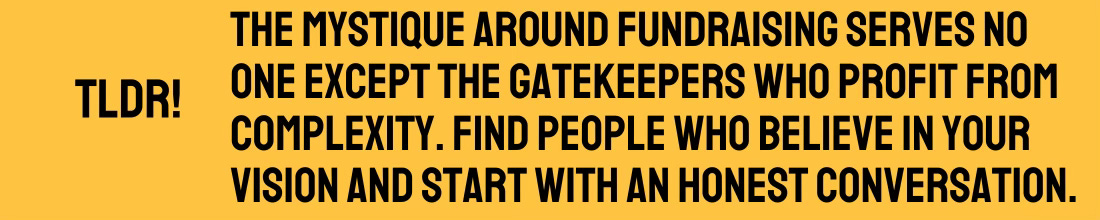
The mystique around fundraising and cap tables serves no one except the gatekeepers who profit from complexity. When you strip away the jargon and expensive intermediaries, it’s really about finding people who believe in your vision and structuring fair deals that align everyone’s interests.
That’s exactly what I accomplished in 21 days—no lawyers, no pitch decks, no months of negotiation, no complex term sheets. Just honest conversations and fair deals. And if you’re building something valuable with the right people, you can do it too.
The gatekeepers don’t want you to know how simple it can be. Now you do.
I have created a playlist on TikTok to document this journey. Tune in to follow along.
Ask Me Anything: Got a burning question about building or scaling your business? Drop me a line at sharon@sharonkgillenwater.com. I personally read every email and respond to as many as possible. The most interesting questions might be featured in future issues (with your permission, of course). No question is too basic or too complex—I'm here to help you succeed!